
Gate 7: How To Scale Your Business
Grow bigger without breaking things
Gate 7- How To Scale Your Business
Ready to Reach More People?
Your product works and you’ve made some money – awesome! So, what’s next? Gate 7 is all about growth: taking your startup from a small operation to something bigger step by step. In this stage, you’ll figure out how to reach more users, boost your production or delivery, and generally scale up without losing what makes your business special. We’ll cover how to plan for growth (so you’re not overwhelmed when things take off), how to keep your customers happy as you expand, and how to build a startup that can handle success. Don’t worry, scaling isn’t about overnight miracles – it’s about smart decisions and knowing when to level up. We’ll show you how
Gate Structure
The Gate is divided into several Keys ( Themes), each focusing on a specific aspect of entrepreneurship. Each Key includes readings, discussions, practical assignments, and business-related deliverables.
Themes you will cover
To achieve this, you’ll explore the following three essential keys:
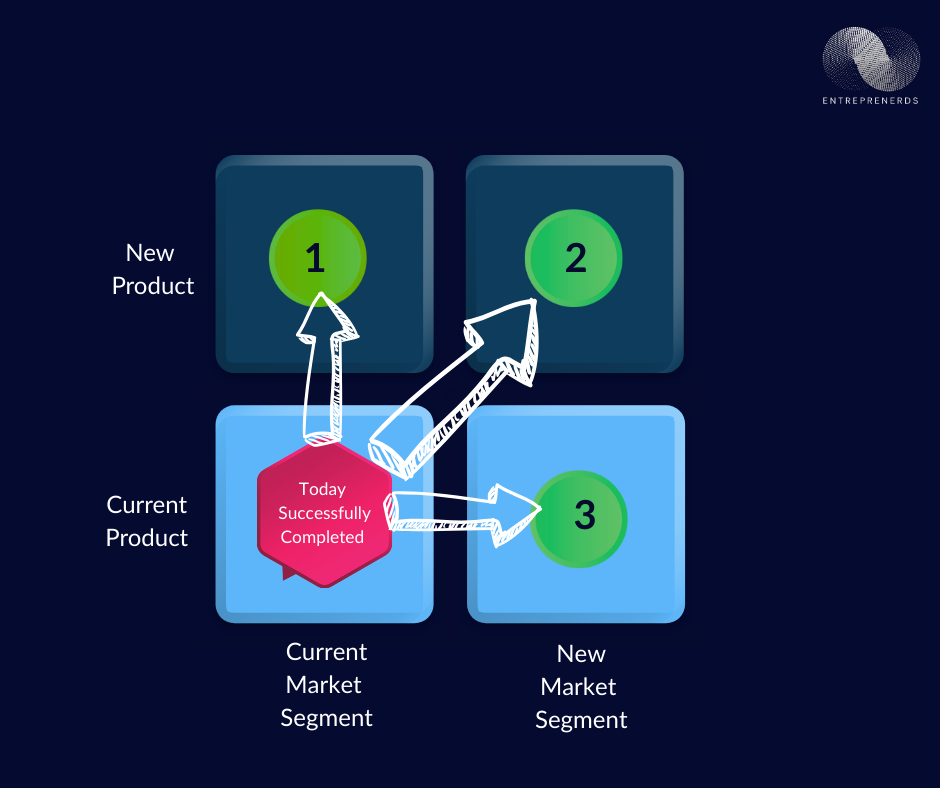
Key1: Identify and Prioritise follow-on markets
Key 2 : Calculate TAM for the follow-on market
Key 3: Define Product Road Map
How we support you
We will provide support throughout your learning experience. Your learning Success manager will be available to support you if you have any questions or need any help. You can also schedule one session with a mentor to discuss entrepreneurship questions related to this gate.
What is Required of You
The Gate is divided into several sections, each focusing on a specific aspect of entrepreneurship. Each module includes readings, discussions, practical assignments, and assessments.
Delivery Platform
The Gate is delivered through our online platform, Entreprenerds Space. Delegates can access the platform online or via their mobile app, allowing them to participate in the programme on the go, even offline.
What you will get from the Gate
By completing this gate, you will be able to:
Learn to create a step-by-step growth plan for your startup – think of it as a roadmap for getting from 100 users to 1,000 (and beyond).
Figure out what parts of your business can be duplicated or automated to handle more customers. (For example, if 10 sales a day works with one person, what happens when it’s 100 sales a day?)
Identify potential growing pains (like customer support, server capacity, or inventory issues) before they happen, and learn how to fix them early.
Discover strategies to reach a larger audience (from viral marketing to partnerships) while keeping your original users happy and engaged.
Build confidence in making big decisions – like when to hire more people or seek investment – by understanding the signs that your startup is ready
Delivery System
Concept Notes
Applications Exercises of each Theme
Videos Explaining Each Concept by Experts and Entrepreneurs
Webinars to discuss the themes with students
Thematic Interactive Discussion with the Learners
Peer Evaluation
Mentorship Session
Virtual Class
Assessments
Badge 1: Market Mapper
-
Skills
1. Identifying follow-on markets
2. Applying the 2-out-of-3 expansion rule
3. Mapping adjacent and upsell opportunities
4. Prioritising market opportunities
5. Visualising TAM expansion
-
User Case
1. Spotting logical next markets after the beachhead is won
2. Minimising risk by changing only one variable: product or customer
3. Designing low-risk, Core-leveraged growth paths
4. Using criteria like customer pull, mission fit, and scalability
5. Creating charts or matrices to communicate growth potential
Badge 2: Scale Strategist
-
Skills
1. Calculating TAM for new markets
2. Top-down market sizing
3. Ranking expansion options
4. Developing a “Now–Next–Later” product roadmap
5. Balancing scaling with quality
6. Presenting your growth story
-
User Case
1. Estimating market size to validate long-term opportunity
2. Building realistic revenue scenarios from public data
3. Making data-driven choices on what to do after MVP success
4. Showing how your product will evolve to match growth
5. Avoiding fast-growth traps by integrating validation steps
6. Creating investor-ready decks showing market vision and roadmap