Zero to Users: How to Find Your First Customers, Keep Them Close, and Build a Community That Does the Growing For You
The unfiltered playbook for early-stage founders who need real humans using their product - not just a waitlist gathering dust.
You have shipped. The product exists. Maybe it is rough, maybe it is brilliant, maybe it is both at the same time. It doesn’t matter. Right now the only number that matters is zero - because that is how many users you have.
Getting from zero to your first 100 users is the hardest thing you will ever do as a founder. Not because it requires genius, but because it requires something most builders are fundamentally allergic to: vulnerability. You have to put something unfinished in front of real people and ask them to care about it.
This article is the playbook for that moment. Not the theory. The actual moves - who to target, where to find them, how to get them in, how to turn their feedback into product gold, and how to transform a handful of early adopters into a community that grows itself. We will cover the roadblocks nobody warns you about, the tactics that actually work, and the smart moves that separate startups that find traction from the ones that quietly disappear.
1. Before You Find Users, Understand What You Are Actually Asking For
Most founders approach early user acquisition like a numbers game. Post on Reddit, blast Product Hunt, DM everyone who might care. They get a spike of sign-ups, a week of silence, and then nothing. The problem is not the channel. It is the misunderstanding of what an early user relationship actually is.
You are not asking someone to use your product. You are asking them to go on a journey with you - to tolerate bugs, incomplete features, confusing onboarding, and broken promises in exchange for being part of something before it becomes obvious. That is a significant ask. And it requires a different kind of person to say yes.
The Early Adopter Profile
Your first users are not average people. They are a specific psychological type described by Everett Rogers in his landmark work Diffusion of Innovations: people who actively seek new solutions, tolerate high uncertainty, and derive social status from being first. They share three traits:
They feel the pain you solve acutely and currently — not theoretically.
They are already trying to solve it with a workaround: spreadsheets, manual processes, or nothing at all.
They are willing to invest time giving feedback, not just consuming.
"Our first ten users were people I had watched hack together solutions in Excel for problems our product was built to solve. They were not happy with the spreadsheet. They were desperate for something better. That desperation is what made them perfect early adopters." — Merci Grace, former Head of Growth, Slack
The single most important thing you can do before acquiring users is define who this person is with terrifying specificity. Not a demographic — a human. Where do they spend their Tuesday afternoons? What podcast are they listening to on the commute? What problem are they complaining about on Twitter at 11pm? The sharper your picture, the faster you find them.
2. The First 10: Go Manual, Go Personal, Go Weird
There is a rule in early-stage companies: do things that do not scale. Paul Graham of Y Combinator has written about this obsessively and it is the single most underrated piece of startup wisdom in existence. Your first ten users should not come from an ad campaign. They should come from you personally. Every single one of them.
The Personal Network Sweep
Write down every person you know. Family, university friends, ex-colleagues, LinkedIn connections, people you met at a conference two years ago. Now filter that list: who has the problem you solve? Do not pitch them. Ask if you can talk. People almost always say yes to a conversation, even when they would say no to a product demo.
Then use second-degree connections. Ask everyone you know to introduce you to one person who might have the problem. A warm introduction converts at dramatically higher rates than any cold outreach.
"The first version of Airbnb was just Brian Chesky and Joe Gebbia going to every conference in San Francisco with cameras and air mattresses. They manually photographed apartments, personally onboarded every host, and stayed in the homes themselves to understand the experience. The first hundred users were people they had personally spoken to."
The Community Infiltration Tactic
Find the online and offline spaces where your ideal users already gather — not to pitch, but to participate. Reddit communities, Discord servers, Slack groups, Facebook groups, LinkedIn communities, Meetup events, niche forums. Spend two weeks just listening and adding value before you ever mention your product.
When you do eventually introduce what you have built, you are not a stranger selling something. You are a community member sharing something relevant. The conversion rate difference is enormous.
The Monzo playbook: Before launching, the Monzo founders spent months in UK personal finance forums listening to frustrations with traditional banks. When they launched their waiting list they did not advertise it — they mentioned it in conversations where it was genuinely relevant. Their first 3,000 cards went to people who felt like they had discovered something, not been marketed to.
The Cold Outreach That Actually Works
Cold outreach has a terrible reputation because most people do it terribly. The formula for cold outreach that converts is:
Hyper-specificity: Reference something specific about them that shows you actually know who they are.
Credibility signal: One line that establishes you are worth their time.
The relevant problem: Name the exact pain point without asking anything yet.
The low-commitment ask: Not 'use my product' but 'would 20 minutes be useful?'
Example message:
"Hi Priya - I saw your post in the Indie Hackers community about struggling to track customer conversations across your team. We have been building something specifically for this. Not asking you to commit to anything - just wondering if 20 minutes of your feedback would be useful? Happy to share early access in return."
Short. Specific. No PDF. No deck. No Calendly link on the first message. Just a human talking to another human.
3. The Roadblocks Nobody Warns You About
Every founder hits the same walls. Knowing they are coming does not make them disappear, but it stops you from interpreting normal friction as fatal failure.
Roadblock #1: The Silence Wall
You launch. You post. You share. And then: nothing. No sign-ups, no replies, no DMs. This does not mean your product is bad. It means your distribution channels have not found the right audience yet, or your message is not landing clearly enough to compel action.
The fix: Stop broadcasting. Start having conversations. One genuine conversation is worth a hundred impressions. Go back to manual, personal outreach.
Roadblock #2: The Enthusiastic Non-User
Someone tells you they love your product, promises to sign up, and then never does. Multiply this by twenty and you have a very confused, discouraged founder.
The fix: "I love it" means nothing. Commitment means everything. The benchmark from Rob Fitzpatrick's The Mom Test: have they already tried to solve this problem? Have they paid money for an alternative? If not, they are being polite, not promising.
Roadblock #3: The Feature Hostage Situation
Early users start requesting features. Lots of them. Some are gold. Most are noise. If you build everything they ask for, you end up with a bloated, incoherent product that serves nobody well.
The fix: Distinguish between symptoms and solutions. When a user says "I need a calendar integration," that is a solution. The symptom is "I keep losing track of when things are due." Build for the symptom, not the requested feature - you will often find a better solution than the one they suggested.
Roadblock #4: The Churn Cliff
Users sign up. They log in once. They never come back. This is the startup killer that disguises itself as a growth problem but is actually an activation problem. People are not seeing enough value fast enough to justify returning.
The fix: Define your ‘aha moment’ - the single instant when a user first experiences the core value of your product. Then ruthlessly reduce the time it takes to reach that moment. Everything in your onboarding should be pointed at getting users there as fast as possible.
Roadblock #5: The Founder Bubble
You have been living with this problem and this product for months or years. You have massive context that users do not have. This context gap makes it nearly impossible to see your product through fresh eyes.
The fix: Watch real people use your product without helping them. No hints, no guidance. Just observe. The moments they hesitate or get confused are your product roadmap.
4. The Engagement Engine: Turning Users Into Collaborators
Getting users is one challenge. Keeping them engaged and extracting product intelligence from their behaviour is another entirely. The founders who build enduring companies treat early users not as customers but as co-creators.
The Onboarding White Glove
For your first 50 users, forget automated onboarding sequences. Onboard every single person manually. Send them a personal welcome message. Offer a 20-minute call. Walk them through the product yourself. This is not scalable and that is exactly the point - you are not trying to scale yet. You are trying to learn.
What you learn from personally onboarding 50 users is worth more than any analytics tool you will ever buy. You will hear the same confusions repeated. You will see where excitement turns to frustration. You will understand the gap between what you thought you built and what you actually built.
"We personally onboarded our first 1,000 users at Stripe. Patrick and John Collison would literally fly to companies and set up payment processing for them. We called it doing things that do not scale and it gave us an understanding of our users that no survey could have replicated." — John Collison, co-founder, Stripe
The Feedback Loop System
Systematic feedback is not asking users 'what do you think?' That question produces polite, useless answers. Specific feedback comes from specific questions:
"What were you trying to do when you last logged in?" (reveals use cases you did not anticipate)
"What is the one thing that almost made you give up and close the tab?" (reveals friction you have become blind to)
"If this product disappeared tomorrow, what would you do instead?" (reveals true competition and switching costs)
"Who else do you know who has this problem?" (the most underused question in early-stage user research)
That last question is particularly powerful. Your best early users are almost always connected to other ideal early users. Asking for referrals at the moment of peak engagement - right after they have had their aha moment - is the most efficient acquisition channel you have.
The Super-User Programme
Within your early user base, a small number of people will stand out: they log in frequently, they send you unprompted feedback, they share your product with others. These are your super-users and they are worth ten times any other user. Treat them accordingly.
Create a formal inner circle for them. Give it a name. Give them early access to new features. Invite them to a private Slack or Discord channel with direct access to you. Ask their opinion before you build anything significant. Make them feel like shareholders in the product’s direction, because functionally they are.
The Notion playbook: In 2018, Notion had under 1 million users but a small core of obsessives who created templates, made YouTube tutorials, and built entire workflows around the product. Notion’s team identified these super-users, featured their templates in the product, and gave them direct access to the team. Those super-users became the foundation of what is now one of the most active product communities on the internet, with over 50,000 templates and a dedicated Reddit community of millions.
The Iteration Broadcast
Every time you ship an update based on user feedback, tell the users whose feedback inspired it. Not a generic changelog. A personal message: "Hey - remember when you mentioned the search bar was confusing? We rebuilt it. Would love to know if it is better."
This closes the feedback loop in a way that feels genuinely human, and demonstrates that engaging with you produces tangible results. Users who see their feedback turned into product features become your most loyal advocates. They have invested in the product. They want it to win.
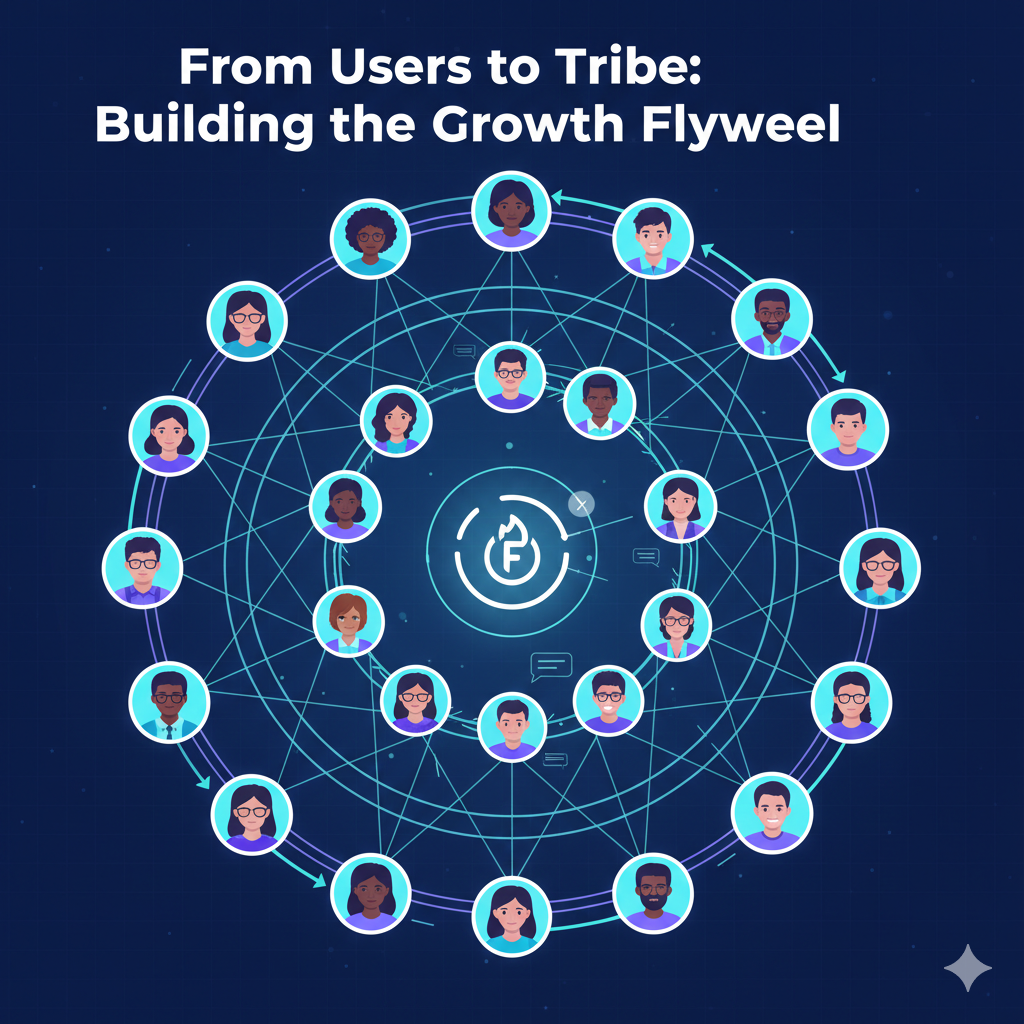
5. Building the Community: From Users to Tribe
A user uses your product. A community member evangelises it. The difference between these two states is belonging. People do not become community members because you asked them to join a Discord server. They become community members when they feel they are part of something with meaning, shared identity, and people they actually want to talk to.
The Community-Before-Scale Window
There is a narrow window early in a company’s life when community building is easiest and most impactful. When you have 100 to 500 users, the network is small enough that everyone can know each other, but large enough to have real conversations. This is your community-building moment.
Miss this window and it becomes exponentially harder. At 10,000 users, launching a community feels manufactured. At 500, it feels organic. The founders who understand this launch community infrastructure early, even when it feels premature.
Platform Selection: Where Does Your Community Live?
The right platform is the one your specific users already use. Do not make people learn new tools to join your community — the friction is too high. The broad options:
Discord: Ideal for technical, gaming, or creator communities. Real-time, conversation-first. Excellent for daily engagement.
Slack: Better for professional and B2B communities. Familiar to people already using it at work.
Circle or Mighty Networks: Purpose-built community platforms with better structure than chat tools. Good for course-based or content-heavy communities.
·Reddit or dedicated forums: High discovery potential. Can grow organically. Harder to moderate early on.
WhatsApp or Telegram groups: Intimate and high-engagement. Works well for smaller, geographically-concentrated communities.
The worst mistake founders make is launching everywhere simultaneously. Pick one platform. Make it excellent. Expand later.
The Community Content Flywheel
Dead communities kill products. Nothing signals irrelevance faster than a server where the last message was posted three weeks ago. In the early days, you and your team are responsible for generating the content that demonstrates the community is alive.
A simple early-stage content calendar:
Monday: Share something you learned or built over the weekend — raw, unpolished, real.
Wednesday: Ask a specific question to the community — "What is the hardest part of [core problem you solve] for you right now?"
Friday: Celebrate a user win publicly — tag them, tell their story, make them feel seen.
The goal is not content production. The goal is demonstrating to new members that the community is worth participating in. Activity breeds activity.
Give Community Members Status
Humans are profoundly motivated by status within their peer groups. Early-stage communities that grow fastest make their most engaged members feel elevated and recognised. Concrete tactics:
Feature users publicly: Spotlight a member each week. Tell their story. Make it genuinely interesting.
Create contribution tiers: Recognise members who answer questions, share content, or refer others.
Make them part of decisions: "We are deciding between feature A and feature B — what does the community think?"
Give exclusive access: Beta features, direct founder access, early news. Exclusivity creates loyalty.
"Monzo’s community forum became the company’s most powerful product development tool. Users did not just suggest features — they debated them, stress-tested them, and built consensus around what mattered most. The Pots feature, now one of the most-used parts of Monzo, came directly from community discussion. Those users later crowdfunded £20 million into the company."
6. Growth Tactics That Actually Work Early On
These are not hacks. They are principles with specific application. Every one of them has a documented track record with real companies.
The Referral Flywheel
The most efficient early growth engine is a user who tells another person about you. But referrals do not happen by default — they happen by design.
Build the ask into the moment of highest satisfaction. After a user completes their first core action successfully, show them: "Know someone who has the same problem? Give them access." Pair this with an incentive: early access, extended free trial, premium features. The incentive does not need to be large — it just needs to exist.
The Dropbox model: Dropbox’s referral programme — give storage, get storage — grew the company from 100,000 to 4,000,000 users in 15 months. The genius was the symmetry: both the referrer and the referred received value. Neither felt like they were doing the other a favour.
The Waitlist as Social Proof Engine
A waitlist is not just a queue. It is a mechanism for creating anticipation, social proof, and community identity before you have shipped a single feature.
How to do it right:
Make position within the queue public. "You are #847 in line. Refer two people to jump to #203." This turns a passive waiting experience into an active game.
Give waitlist members something exclusive: insider updates, naming rights on a feature, founder Q&A sessions.
Document the journey publicly. Share progress, decisions, setbacks. The people on your waitlist become invested in your success because they have watched it unfold.
"Superhuman, the email client, maintained an 18-month waitlist before public launch. Every person who got access felt like they had won something. The scarcity created demand. The personalised onboarding created word-of-mouth. They launched to an audience that was already evangelising the product before most people had used it."
The Platform Arbitrage Move
Every new platform or community has an early period of high organic reach before it becomes saturated. The founders who grow fastest identify these moments and move first.
TikTok had extraordinarily high organic reach in 2019-2020. LinkedIn’s algorithm was wildly generous to native text posts in 2018. Substack’s referral programme drove massive cross-growth in 2021. The founders building audiences during those windows did not work harder than everyone else. They moved faster.
Right now: identify one platform where your ideal users are present but underserved by good content in your space. Own that platform for 90 days before anyone else does.
The Content-as-Distribution Strategy
The cheapest acquisition channel available to an early-stage founder is genuine expertise shared publicly. Not marketing content. Not product announcements. Raw, useful knowledge about the problem your product solves.
If you are building a tool for freelance designers, write the definitive guide to freelance client management. If you are building for restaurant owners, document everything you have learned about their operational challenges. The people who read it and find it genuinely useful are precisely your target users.
The HubSpot model: HubSpot built an entire marketing category — inbound marketing - not to describe their product but to educate their customers. Their blog became the most visited marketing resource on the internet. Their users came to them pre-educated, pre-sold, and deeply loyal.
The Partnership Shortcut
Find companies or communities that already have access to your ideal user but are not your direct competitors. Offer genuine value in exchange for distribution:
A complementary tool that integrates with yours and promotes each other
A guest post or webinar for an established community in your space
A co-created resource - research report, guide, tool — that both parties promote to their audiences
An affiliate relationship with creators or influencers in your niche
"Slack did not grow through advertising. It grew through integrations. Every tool that integrated with Slack became a distribution channel. Developers who built on the platform had an incentive to promote it. The product was the marketing."
7. Smart Moves Most Founders Miss
These are the moves that separate the founders who build something lasting from those who build something temporarily interesting.
Move #1: Make Onboarding Embarrassingly Simple
Every step between sign-up and first value costs you users. Industry data consistently shows that the average app loses 40-60% of new users within the first day. The primary cause is almost always onboarding friction: too many fields, too many steps, too much required before a user experiences any value.
The question is not what do we need from users before they start. The question is what is the absolute minimum they need to experience value. Everything else can wait.
Move #2: Build in Public
Building in public — sharing your process, decisions, failures, and wins openly — is the highest-leverage thing a first-time founder can do for distribution. It creates an audience before you have a product. It humanises your brand. It generates accountability that forces execution.
The format matters less than the consistency. Show up every week, share something real, and compound over 12 months.
Move #3: Give Before You Ask
The fastest way to build an audience of future users is to be genuinely useful to them before you have anything to sell. Write the guide they need. Answer the question nobody else is answering clearly. Create the tool that solves the smaller adjacent problem for free. Build the asset. The users follow.
This is not altruism. It is the most commercially rational strategy for early-stage acquisition because it builds trust at scale before any transaction occurs.
Move #4: Instrument Everything, Act on One Thing
Early founders either track nothing and fly blind, or track everything and drown in data. The right approach is to identify the single metric that most closely correlates with user success in your product — the North Star Metric — and make every product decision in service of that one number.
For Airbnb it was nights booked. For Facebook it was friends connected in the first 10 days. For Slack it was messages sent. What is yours? Find it, and let it make decisions for you when you are uncertain.
Move #5: Turn Negative Experiences Into Loyalty
When an early user hits a bug, gets confused, or has a bad experience and you respond within the hour with a personal message and a fix, something counterintuitive happens: they become more loyal than users who never had a problem. This is called the Service Recovery Paradox and it is one of the most powerful dynamics in early community building.
Treat every complaint as a gift and an opportunity. The user who tells you something is broken is doing more for your company than the ten users who silently churned.
8. The Community Growth Flywheel
Once you have 200-300 users and a functioning community, something changes. If you have built the infrastructure correctly, the community begins to grow itself. Users refer users. Members answer each other’s questions. Content gets created without you asking for it. This is the flywheel state.
Getting there requires:
Identity: Members should be able to describe themselves as part of something. Not just 'I use this tool' but 'I am part of this community.'
Rituals: Regular events, calls, or content that members can anticipate and participate in together.
Lore: Shared stories, jokes, and history that newcomers learn and veterans celebrate. 'We were there when...' is powerful glue.
Member-generated value: A community where value flows only from the founder is a newsletter with extra steps. Real community emerges when members create value for each other.
"We did not build a community for BrewDog. We built a movement. Our Equity for Punks investors were not customers - they were shareholders in a rebellion against bland beer. That identity, that shared enemy and shared vision, was the engine that drove everything." - James Watt, co-founder, BrewDog
The Long Game
None of this is fast. None of it is algorithmic. Getting from zero to a self-sustaining community of users who love your product and tell others about it takes, on average, 18 to 24 months of consistent, manual, personal work. There are no shortcuts.
But here is what makes it worth it: the founders who do this work early build something that money cannot buy. An audience of people who trust you. A feedback loop that tells you what to build before you build it. A distribution channel that costs nothing to operate and compounds with every new member.
Your first 10 users are not just early adopters. They are the seed of every user you will ever have. Treat them like the rare and irreplaceable asset they are. Be obsessively useful to them. Learn from every conversation. Ship fast, break things, fix them in public. Build the community before the product demands it.
The best growth strategy ever invented is a product people genuinely love, in the hands of people who feel ownership over its success. Everything else is amplification.
Your turn: Who are the first 10 people you are going to contact this week? Not broadcast to. Not advertise at. Contact personally, by name, with a specific and genuine ask. Share your approach in the comments.
This article is part of the Entreprenerds blog series on practical entrepreneurship for young founders 19–24. Explore the full 10 Gates framework at https://www.entreprenerds.uk/10-gates-1