Market Sizing: Why Most Founders Get TAM, SAM, and SOM Dangerously Wrong

Before you pitch an investor or write a line of code, you need to understand your market, who you’re serving, how many of them exist, and what slice of that group you can realistically win. This is more than just a slide in your deck, it's the backbone of your go-to-market strategy.
There is a classic slide in many failed pitch decks: "The global market for [Industry X] is $100 Billion. If we capture just 1%, we’ll be a billion-dollar company."
To an investor, this isn't an ambitious statement—it’s a confession of laziness. It’s called the "1% Fallacy," and it happens when founders fail to distinguish between the dream and the deliverable. To build a venture-scale company, you need to understand the three layers of your market not as abstract circles, but as a roadmap for execution.
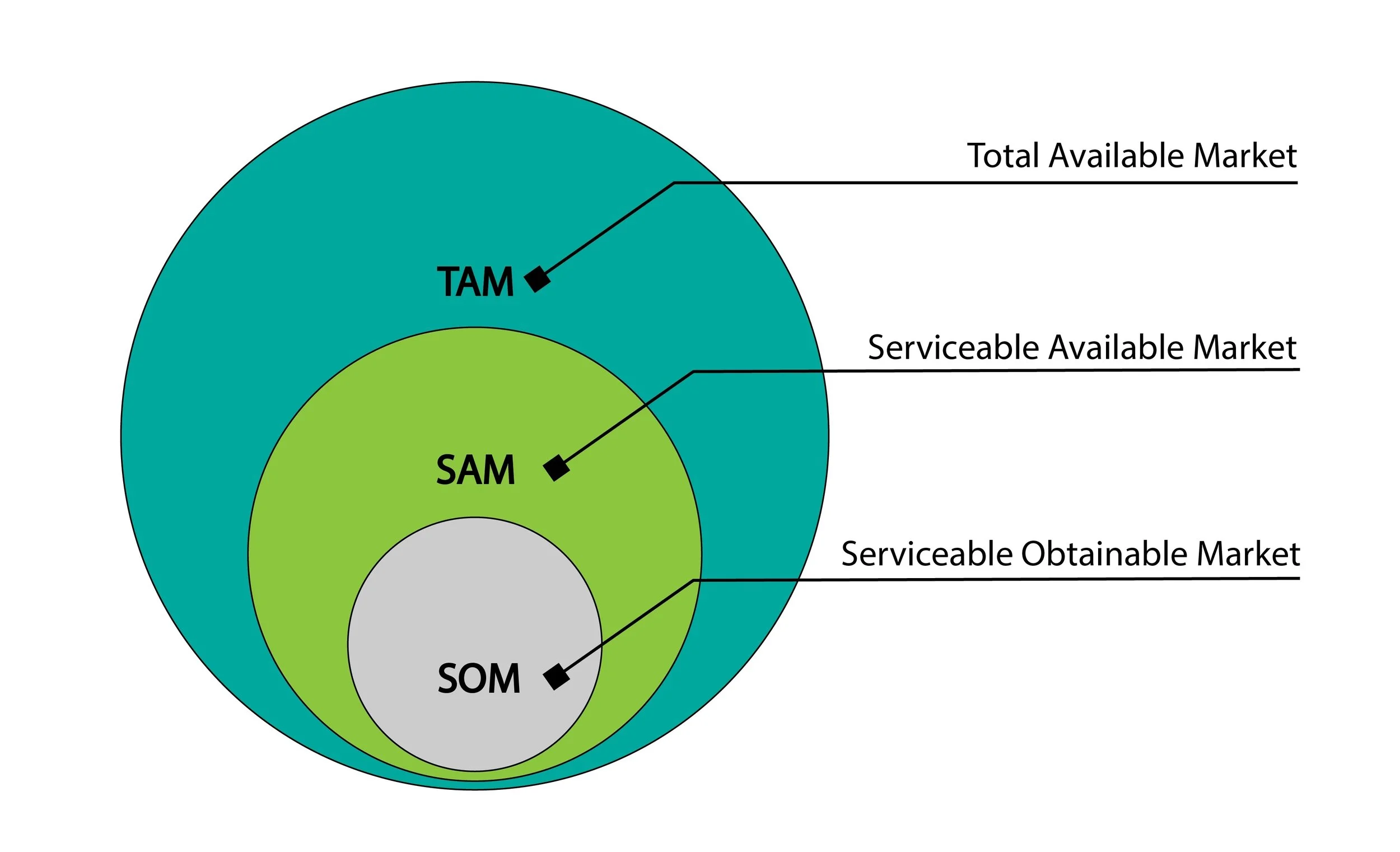
1. The Definitions: The Nested Reality
Before we argue which one matters most, we must define them with precision.
TAM (Total Addressable Market): The Long-Term Vision. This is the 100% market share scenario.2 If you had no competitors and every potential user in the world bought your product, how much revenue would you generate?
Insight: TAM tells you if the category is worth your time. If your TAM is $50M, you aren't a venture-scale startup; you’re a niche business.
SAM (Serviceable Addressable Market): The Geographic & Model Fit. You can't reach everyone at once. SAM filters the TAM by your current business model, geography, and language.
Example: If your TAM is "Global Pet Food," but your startup only delivers fresh, refrigerated meals in Western Europe, your SAM is the European fresh pet food segment.
SOM (Serviceable Obtainable Market): The Execution Truth. This is the slice of the SAM that you can realistically capture in the next 2–3 years with your current resources, sales team, and budget. It factors in competition and the friction of the real world. SOM is your short-term revenue battlefield, the piece of the market you can actually win, based on your current capabilities.
2. The Argument: Why Founders Should Obsess Over SOM (Not TAM)
While investors want to see a massive TAM to justify the "billion-dollar exit" potential, they invest in your SOM. Here is why the SOM is the most critical metric for a founder:
A. It Proves "Go-to-Market" (GTM) Credibility
Anyone can pull a $50B industry report from Gartner (Top-Down). However, showing a calculated SOM proves you understand your sales cycle. If your SOM is $5M, and your product costs $5k/year, you are telling the investor: "I know I need to close 1,000 customers in the next 24 months to hit my goal." That is a plan; "1% of China" is a wish.
B. It Validates Your Unit Economics
Calculating SOM requires a Bottom-Up approach. Instead of starting with a huge number and slicing it, you start with:
$$SOM = (\text{Number of reachable customers}) \times (\text{Average Revenue Per User})$$
This forces you to confront reality: is your pricing, sales model, and customer base strong enough to support a viable business?
3. The Practical Details: Top-Down vs. Bottom-Up
The Top-Down Approach
The Method: You start with a large, aggregate number from industry research (like IDC, Forrester, or Gartner) and apply percentages to narrow it down to your slice.
Best For: Setting the high-level, long-term "dream" or vision for your company (TAM).
The Risk: It carries a high risk of being generic and unrealistic. It often leads to the "1% Fallacy," where founders assume they can capture a small percentage of a huge market without explaining how.
The Bottom-Up Approach
The Method: You count specific, identifiable customers (using tools like LinkedIn, industry databases, or your own CRM) and multiply that count by your actual price point.
Best For: Proving the immediate business opportunity and your execution strategy (SOM).
The Risk: It requires significantly more work, boots-on-the-ground research, and deep market knowledge. However, this is the methodology that investors find most credible.
Pro-Tip: Always use a Bottom-Up approach for your SOM. If you can’t name the specific types of companies or individuals that make up your first $1M in revenue, you haven't done your homework.
4. Common Pitfalls to Avoid
The "Broad Category" Trap: If you're building a specialized AI for cardiologists, your TAM isn't "The Global Healthcare Market" ($12 Trillion). It's "The Cardiovascular Diagnostics Software Market." Over-inflating your TAM makes you look like you don't understand your niche.
Ignoring the "Status Quo" as a Competitor: When calculating SOM, founders often forget that their biggest competitor isn't another startup—it's the customer doing nothing or using Excel. Your SOM must account for the difficulty of changing human behavior.
Static Sizing: Markets move. A great founder explains how their TAM is expanding. (e.g., Uber’s TAM wasn’t just the "Taxi Market"; it was the "Transportation Market" because their lower friction created new users).
Focus on the "Obtainable"
Investors don't fund companies because the market is big; they fund them because the founder has a credible plan to capture a specific piece of it. TAM gets you the meeting, but a rigorous, bottom-up SOM gets you the term sheet, Market sizing isn’t a spreadsheet exercise, it’s a strategic lens. TAM might get attention, but SOM earns investment. Ground your strategy in specifics, not dreams
Explore Gate 2 of the Entreprenerds Programme, where we help founders define real beachhead markets and validate assumptions with precision.