High-Level Product Specification: Turning Insight into a Tangible Vision
You’ve done the hard yards. You’ve sat across from customers and listened to their frustrations. You’ve mapped your Persona until you know their daily routine better than your own. You’ve charted the Full Life Cycle Use Case, identifying exactly where the friction lies.
Now comes the most exciting - and often most nerve-wracking - part of the journey: making it real.
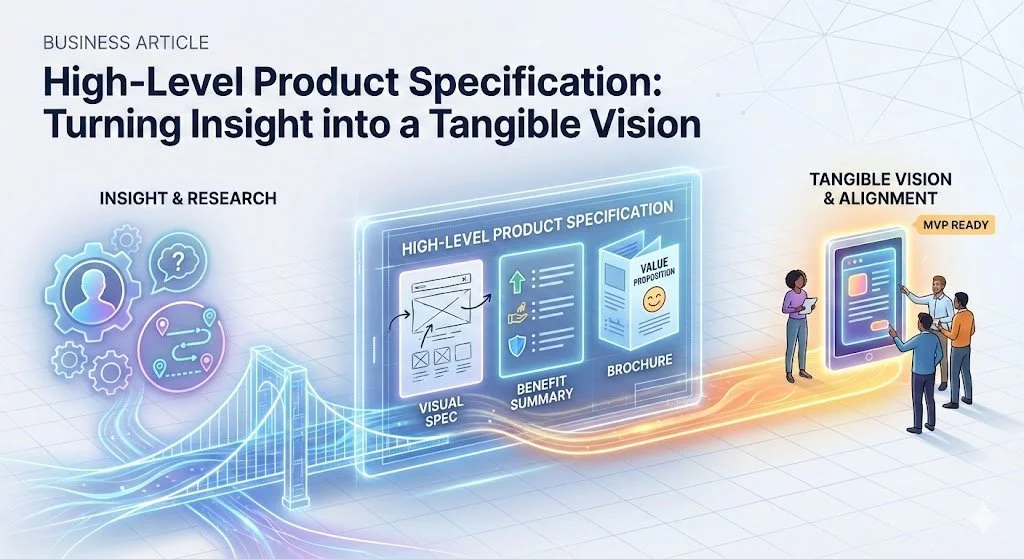
In Gate 3 of the Entreprenerds Programme, we shift from the world of research into the world of solution design. This begins with the High-Level Product Specification (HLPS). This isn't just a document; it’s the bridge between a theoretical opportunity and a tangible business.
What Is a High-Level Product Specification?
At its core, a High-Level Product Specification is a lightweight blueprint. It is a visual and written summary of what your product is, who it’s for, and why they should care.
It is important to define what it isn't: it is not a 50-page technical requirement document for engineers. It’s a communication tool designed to be understood by a customer in 60 seconds.
The Anatomy of an HLPS
The Three Pillars of Your Product Vision
The journey of the High-Level Product Specification is built upon three essential elements that move your idea from the abstract to the concrete.
Firstly, you have the Visual Spec. This is the "eye" of your project. It’s where you move past words and into the realm of experience. Whether it is a hand-drawn storyboard, a rough sketch, or a low-fidelity wireframe, the goal isn't aesthetic perfection—it is to capture the flow and feel of the solution. It answers the question: What does it actually look like when a human interacts with this idea?
Interwoven with the visual is the Benefit Summary. If the visual spec is the "eye," this is the "soul" of the product. Rather than listing technical functions or "cool" features, you distill the product into 3–5 bullet points focused entirely on outcomes. This is your opportunity to answer the customer’s ultimate question: "So what?" By focusing on how their life changes after using your product, you ensure the technology serves the user, rather than the other way around.
Finally, you bring it all together in the Brochure. Think of this as the "voice" of your product—a one-page advertisement for a solution that doesn’t fully exist yet. This isn't just a marketing exercise; it is a diagnostic tool. By presenting your idea as a finished value proposition, you can test if it actually resonates in the real world. It forces you to be concise, compelling, and honest about what you are offering, allowing you to gauge customer interest before a single line of code is written.
Together, these three elements transform your insights into a tangible vision that people can see, feel, and—most importantly—critique.
Why This Step is Non-Negotiable
Building a startup is a race against time and resources. Far too many founders start coding or manufacturing before they’ve validated the vision.
1. Align Your Team (The "Internal" Why)
It’s common for co-founders to think they are building the same thing, only to realize six months later that one was envisioning a premium concierge service while the other was building a self-service SaaS. A visual spec forces a "consensus of reality."
2. Low-Stakes Failure
It is much easier to delete a slide or redraw a sketch than it is to rewrite 5,000 lines of code. The HLPS allows you to "fail" in the design phase, where the cost of a mistake is almost zero.
3. High-Value Feedback
When you ask a customer, "What do you think of this idea?", they are often too polite to tell you it’s bad. When you show them a brochure with a price point, their reaction becomes much more honest.
"High-Level Product Specs help you engage the potential customer with your solution—and iterate with them, not just for them."
The 5-Part Process for Creating Your Spec
1. Shift from Inquiry to Advocacy
Up until now, you’ve been a "detective"—asking open-ended questions. Now, you become an "advocate." You are proposing a specific way to solve a problem. However, keep your ego in check. Your mindset should be: "I am confident in this solution, but I am looking for you to prove me wrong."
2. Create the Visual Spec
Don't worry about being an artist. The goal is clarity, not beauty.
The Storyboard: If your product is a physical service, draw the steps of the customer experience.
The Mock-up: If it’s an app, use tools like Figma or even paper sketches to show the 2–3 most important screens.
The Focus: Only show the features that solve the Persona’s top three priorities. Everything else is noise.
3. Align with the Persona
Go back to your Persona profile. Does your spec reflect their actual environment?
If your persona is a busy construction foreman, is your interface too "fussy" for a tablet being used on-site?
If your persona is a CFO, does the brochure highlight "cost savings" and "compliance," or just "cool tech"?
4. Build the "Smoke Test" Brochure
Create a one-pager as if the product were launching tomorrow. It should include:
The Hook: A headline that speaks to the primary pain point.
The Value: How their life is better after using your product.
The Call to Action: What should they do next? (e.g., "Join the pilot group," "Pre-order now").
5. Test and Iterate
Take your visual spec and brochure to 5–10 people who fit your Persona. Don't pitch it—show it.
Watch their eyes: Where do they linger? Where do they look confused?
Ask: "If you had this today, what's the first thing you'd do with it?"
Listen for: "I like it, but..." The "but" is where your future product lives.
What This Prepares You For
The HLPS is the "North Star" for the next phase of your company. Once you’ve validated this spec, you have the green light to:
Define the MVP: You now know which features are essential and which can wait.
Set Pricing: You can begin testing what the value is worth to the customer.
Start Building: Your developers or manufacturers now have a visual guide to follow.
Final Thought
"The best products don’t start with features. They start with clarity."
The High-Level Product Specification is the moment you stop guessing and start visualizing. It’s the moment you offer your customer a vision of what life could look like with your solution in their hand.